



Buying Guide
How to Buy an Air Fryer
This short guide helps you choose the right air fryer by covering the key factors to consider, the main types available, must-have features and specifications, plus where to buy, common mistakes to avoid and quick expert tips to get cooking fast.
Key factors to consider
Capacity and household size
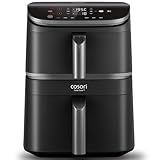
- Match capacity to how you cook: compact units suit 1 to 3 people, mid-size 3 to 5 people, and larger or dual-drawer units suit families or full meals. Example capacities found: 4.7L, 6L, 8.5L, 9.5L and a flexible 10L that can split into two zones.
- Check actual dimensions and leave clearance for ventilation and drawer opening. A compact machine may still be deep or tall.
- Look at wattage and claimed energy savings. Some machines use around 1.5kW and can be noticeably faster and more efficient than a conventional oven.
- Decide whether you need simple presets or advanced functions like dehydrating, proofing and sync-cooking two foods at once.
- Prefer removable non-stick baskets and dishwasher-safe parts. Confirm warranty and local customer support, typically around two years on many models.

Types and sizes
Main formats to choose from
- Single-basket compact: Best for kitchens with limited space and for 1 to 3 people.
- Mid-size family fryer: Balances capacity and footprint for 3 to 5 people, often 6L to 8.5L.
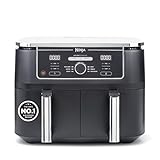
- Dual-drawer or dual-zone: Two independent baskets let you cook different foods at different settings or finish together; useful for households with varying tastes.
- Large flexible-option: A single large cavity with a divider gives the choice of one large basket or two smaller zones for maximum versatility.
Important features and specifications to look for
Heating and airflow
- Even heating is crucial. Look for multi-element designs and good fan circulation to avoid uneven results.
- A wide range (roughly 30 to 240°C or similar) lets you air fry, bake, roast and dehydrate. Precise digital controls and clear displays make a difference.
- Many models offer 8 to 11 cooking modes including air fry, roast, bake, grill, reheat and dehydrate. Check what you will actually use.
- Some units run quietly at around 55 dB. Look for sturdy non-stick baskets, tempered glass displays if you prefer a modern look, and supplied accessories such as crisper plates.
- Power rating (for cook speed), removable dishwasher-safe parts for easy cleaning, supplied recipe resources and available accessories. Confirm whether smart features require companion apps and if any regional restrictions apply.

Where to buy, common mistakes and expert tips
Online versus in-store
- Buy online to compare prices, reviews and delivery options quickly. Buy in-store if you want to check size, controls and build before purchase.
- Buying by headline capacity only without checking usable space and basket shape.
- Choosing a model that is too small for family meals or too large for your worktop and storage.
- Assuming preset times are universal; do a test run to learn timings for your recipes.
- Measure the space where the unit will sit and the dimensions of the drawer before ordering.
- If you often cook different dishes at once, choose a dual-zone or divider model for true flexibility.
- Prioritise dishwasher-safe baskets and removable crisper plates to save time cleaning.
- Look for a minimum two year warranty and UK support when possible.
- Start with manufacturer or chef recipes to learn timings, then adjust for your preferred crispness.
Final Thoughts
Choose a model that matches your household size, kitchen space and cooking habits. Prioritise even heating, sufficient capacity, easy cleaning and a solid warranty. Measure first, compare specs second, and buy from a retailer that offers clear returns and local support.


![Russell Hobbs Air Fryer [8.3L,Max 200℃, 1800W] (9 Programs, Oil Free Cooking, Rapid Air Technology, Touchscreen, Auto Shut-Off, Keep warm, Roast, Bake, Grill, Dishwasher safe parts) Satisfry 27632](https://m.media-amazon.com/images/I/31uoIX6+TWL._SL160_.jpg)