



Buying Guide
How to Buy a Folding or Under-Desk Treadmill
This short guide helps you choose a compact folding or under-desk treadmill by highlighting the most important factors, the common types available, the key specs to check and practical buying tips. Use it to spot the right model quickly and avoid common mistakes.
Key factors to consider
Decide how you will use the machine - walking while working, brisk walking, jogging or regular running. Prioritise these elements:
- Speed range - 1 to 12 km/h suits walking, brisk walking and light running; pick higher top speeds if you plan to run regularly.
- Motor power - units quoted around 2.5 to 3.0 HP or 1 400 W are common; stronger motors resist overheating and keep speed stable under load.
- Weight capacity - models typically support 120 to 136 kg; choose one with at least 10 to 20% margin over your weight for durability.
- Running deck size - a belt roughly 40 cm wide and 100 to 127 cm long is standard for compact treadmills; longer belts are more comfortable for running.
- Noise - look for machines rated below about 50 dB for home and office use.
- Storage and portability - check folded thickness, wheels and whether the handrail collapses if you need to store it under furniture.


Types and categories
Compact treadmills fall into a few practical categories:
- Under-desk walking pads - very low profile, best for walking while working and light moving between tasks.
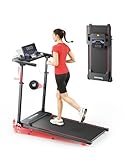
- Folding treadmills with retractable handrail - balance portability with stability; handrail folds away for storage.
- Incline-capable models - offer manual or adjustable incline settings typically from a few percent up to 10 to 15 percent for hill training and extra calorie burn.
- Workstation hybrids - include a larger device holder or small table for a laptop and often integrate app control for workouts.
Important features and specifications to check
Check these specific features before you buy:
- Actual belt dimensions and usable running area - confirm the width and length rather than trusting marketing phrases.
- Shock absorption - multiple layers and silicone or rubber absorbers reduce impact on joints; 5 to 8 layers is common.
- Controls - physical buttons, a magnetic safety key and a remote are useful; apps and shortcut speed buttons add convenience.
- Incline - if you want more intensity pick a model with a manual or powered incline of 5 to 15%.
- Noise and motor duty - look for quiet operation below about 50 dB and a motor rated for continuous or peak power suitable for running.
- Build and warranty - check frame quality, aftercare and availability of spare parts.
- Folded dimensions - many compact units fold to around 5 to 14 cm thickness; ensure it fits your storage spot.

Where to buy, common mistakes to avoid and expert tips
Online retailers give the widest choice and often better prices; local shops let you inspect build quality and hear noise levels. Before buying online confirm delivery, returns and installation terms. Common mistakes to avoid:
- Buying on price alone - very cheap units often skimp on motor, belt size or shock absorption.
- Choosing too small a belt - restricts stride and makes running unsafe.
- Ignoring weight capacity - operating close to the limit shortens lifespan.
- Assuming app features equal quality - check core hardware first.
- Measure the intended space and entryways before ordering.
- If you plan to run choose a model with higher motor power and a longer belt.
- Prefer units with multiple shock layers if you have joint concerns.
- Allow budget for a good mat if your floor is hard; it reduces noise and protects the deck.
- Check reviews for reliability and for how responsive the seller is after sale.
Final Thoughts
Choose a model that matches your main use - walking at a desk needs a low, quiet pad while running needs more motor power and a longer belt. Verify belt size, motor spec, weight capacity and storage dimensions before you buy, and confirm returns and aftercare when buying online. Small extra spend on a sturdier unit pays off in comfort and reliability.


