




Buying Guide
How to Buy a Deep Tissue Massage Gun
This short guide explains what to look for when buying a handheld percussion massage gun, how types differ, where to buy and common pitfalls to avoid. It draws on real product features so you can act quickly and choose the right device for your needs.
Key factors to consider
Power and penetration depth
- Amplitude (mm) shows how deep the head travels. Typical values range from about 6mm to 16mm. Deeper amplitudes give stronger, more targeted relief for large muscles.
- Stall force or torque (measured in pounds) indicates how much pressure the motor can handle before slowing. Higher values mean the device will maintain speed under load.
- Look at the RPM range. Common practical ranges are 1,200 to 3,300 RPM; adjustable speeds let you tailor intensity.
- Brushless motors run quieter and last longer than brushed motors.
- Battery capacity varies from around 2,600mAh to 4,000mAh or more. Higher capacity usually means longer runtime.
- USB-C and fast charging (for example 20W PD) are convenient for topping up quickly.
- Noise levels matter if you use the device in shared spaces; typical quiet models operate under 45dB to 50dB, while some advertise 30dB at low loads.
- Weight and handle design affect how easy it is to reach shoulders and back. Look for compact or detachable-handle designs for hard-to-reach areas.
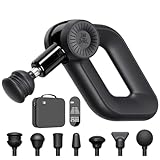
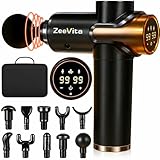
- Attachments: count of heads and materials. Silicone heads are washable and gentler for sensitive areas.
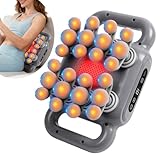
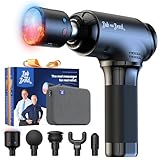
- Therapies: some devices offer heat or cold therapy built into a head for accelerated relief.
- Controls: screens, presets, auto-shutdown timers and intelligent pressure sensors improve safety and usability.

Types and feature trade-offs
Full-size percussive guns
- Best for athletes and heavy use. Expect deep amplitude (10mm to 16mm), high stall force and multiple speed levels. Heavier and pricier but more effective on large muscle groups.
- Lighter and cheaper, with smaller amplitude (around 6mm) and lower stall force. Good for everyday muscle tension and portability but less effective for deep tissue work.
- Units with heat or cold heads add recovery options but increase cost and complexity.
- Models with detachable or extended handles help reach the upper back and shoulders without a second person.
- Budget models under about £60 cover basic percussion and portability.
- Mid-range devices around £60 to £110 typically add better motors, longer battery life and more heads.
- Premium devices above £110 often add deep amplitude, stronger stall force, screens, fast PD charging and quieter motors.
Where to buy, common mistakes and practical buying tips
Online versus retail
- Online: compare full specifications, customer reviews and seller warranty details. Look for clear runtime, amplitude and noise specs and check the returns policy.
- Retail: try the weight, grip and noise in person and check how comfortable different heads feel. You cannot test battery life though.
- Choosing only by headline power or marketing photos. Check amplitude and stall force for real performance.
- Buying too powerful too soon. If new to percussion therapy, start with lower speeds and smaller amplitudes.
- Ignoring charging type and battery life. USB-C and fast-charge support are practical for regular use.
- Overlooking noise and build quality. A quiet brushless motor and sturdy casing matter for long term enjoyment.
- Confirm amplitude, RPM range and stall force in the spec sheet.
- Check included heads, case and warranty length.
- Read recent user reviews about durability and after-sales support.

Expert tips and final checklist
How to use safely and get the best results
- Start on the lowest setting and increase gradually. Max sessions per area should be short - typically 1 to 2 minutes per spot.
- Use softer heads and lower speeds on bony areas and sensitive spots.
- Auto-shutdown timers and intelligent pressure sensors are useful safety features to prevent overuse.
- Desired depth: choose around 6mm for light use, 10mm for general deep tissue, 16mm for intensive recovery.
- Battery: aim for 3,000mAh or more if you need long runtime between charges.
- Noise: under 50dB is reasonable; under 45dB is better for quiet environments.
- Extras: USB-C charging, at least 4 heads, carry case and a clear warranty.
Final Thoughts
Choose the smallest number of features that meet your real needs rather than the highest spec available. If you want portability and convenience, pick a compact model with USB-C and a good battery. If you need serious recovery, opt for a full-size unit with deeper amplitude and higher stall force. Always read recent user reviews, check warranty terms and start slow when you first use the device.


