



Buying Guide
How to Buy an Oil-Filled Electric Radiator
This short guide helps you choose the right oil-filled electric radiator by covering what to consider, the main types, key specifications to check, where to buy and common pitfalls. Use it to decide quickly and confidently.
Key factors to consider
Match wattage to room size, safety and controls.
- Wattage and room coverage: smaller rooms need around 1000W, medium rooms about 1500W, and larger rooms 2000W to 2500W (products here claim coverage up to about 24 to 25m² at the high end).
- Placement: decide between a freestanding model with castors or a wall-mounted unit if you need to save floor space.
- Energy use: look for thermostats, multiple heat settings and timers to limit running time; oil-filled designs hold heat so they keep warming after switching off.
- Safety: essential features include overheat cut-out, tip-over protection for portable models and an IP rating if you plan to use it in a bathroom.
- Practical details: check cable length, supplied brackets, weight and whether the controls are digital or manual.


Types and important features to look for
Know the common types and the features that matter.
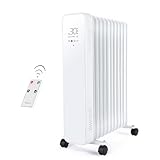
- Freestanding portable radiators: usually 9 to 11 fins, 4 wheels and a handle for moving between rooms; ideal if you want flexibility.
- Wall-mounted radiators: slimmer profiles and good for saving space in small rooms; check that wall fixings are included and rated for the heater's weight.
- Controls and programming: choose models with a thermostat plus 24-hour or 7-day timers and adjustable heat settings (typically 1000W, 1500W and 2500W) for better efficiency.
- Build details: more fins and larger surface area spread heat more evenly; look for sturdy aluminium or steel construction and rounded fin edges for safety.
- Safety extras: keypad lock, LED display with child lock, automatic shut-off and waterproofing for bathroom-safe units.
Where to buy and common mistakes to avoid
Decide between online and in-store, and avoid these traps.
- Online shopping: wider selection and easier price comparison. Check delivery times, clear product dimensions, return policy and warranty before buying.
- Retail stores: handy for checking build quality, size and weight in person and getting installation advice for wall-mounted units.
- Common mistakes: buying too large or too small a unit for the room, ignoring safety ratings, assuming wall brackets are supplied, forgetting to check cable length and plug type, and prioritising lowest price over features like thermostat and timer.
- Budget note: options in the range shown here vary from about £50 to under £300. Balance features and safety with price.

Expert tips and quick recommendations
Actionable advice to help you choose and use your heater safely and efficiently.
- Measure the room and pick wattage accordingly: approx 1000W for small rooms, 1500W for medium rooms, 2000W to 2500W for larger rooms up to roughly 24 to 25m².
- Prioritise a thermostat plus a 24-hour or 7-day timer to reduce running costs and avoid overheating.
- Choose wall-mount if you lack floor space, but ensure the wall fixings and cable length are suitable.
- If using in a bathroom, only buy units with the correct IP rating for the zone.
- On arrival, register the product for warranty, test all controls and keep the manual for maintenance instructions.
Final Thoughts
Pick a heater by first measuring the room, then matching the wattage and features to how you will use it. Opt for a model with thermostat control, timer and core safety protections. If you need mobility choose a freestanding model with wheels; if space is limited choose wall-mounted with supplied fixings. Buy from a seller that offers clear dimensions, a fair returns policy and a warranty so you can install and test with confidence.


