



Buying Guide
How to Buy a Children's Activity Table
This short guide helps you choose the right activity table for drawing, train play, sensory games or study. It covers what to check, the main types available, the must-have specifications and where to buy so you can decide quickly and confidently.
What to consider before you buy
Age and stage
- Pick a table suited to your child's age and coordination. Many sets are best from 3 years old, while art or sensory tables may suit younger toddlers under supervision.
Space and footprint
- Measure the area where the table will sit and allow room for chairs and play around it. Typical table prices in the selection range from about £70 to £100 for a mid-size unit.
Longevity and material
- Solid wood or thick plywood lasts longer than thin MDF. Look for reinforced frames or stated board thickness if you want a table to last several years.
Safety and maintenance
- Seek rounded corners, anti-pinch handles on lift tops, non-toxic finishes and easy-clean surfaces. Smooth, wipeable tops make craft clean-up simple.
- Pick a table suited to your child's age and coordination. Many sets are best from 3 years old, while art or sensory tables may suit younger toddlers under supervision.
Space and footprint
- Measure the area where the table will sit and allow room for chairs and play around it. Typical table prices in the selection range from about £70 to £100 for a mid-size unit.
Longevity and material
- Solid wood or thick plywood lasts longer than thin MDF. Look for reinforced frames or stated board thickness if you want a table to last several years.
Safety and maintenance
- Seek rounded corners, anti-pinch handles on lift tops, non-toxic finishes and easy-clean surfaces. Smooth, wipeable tops make craft clean-up simple.


Types and what they are best for
- Art and lift-top tables: Ideal for painting and drawing. Look for a lift-top or paper roll system to make artwork easier to change.
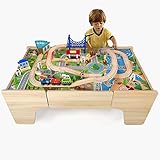
- Train and play tables: Designed with tracks and often include dozens of accessories. Best for imaginative play and sharing with siblings.
- Sensory and sand/water tables: Feature removable bins for sand, water or sensory fillers and often have reversible lids that double as drawing surfaces.
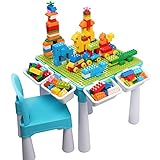
- Desk and chair sets: Simpler tables with built-in storage for study and crafts; good for smaller spaces and group play.
Key features and specifications to check
Materials and build
- Prefer thicker timber or plywood where possible; one good benchmark is around 20mm plus for main panels. Check if the frame mentions reinforced construction.
Storage and organisation
- Removable boxes, fabric drawers or large storage bins (for example 20+ litre capacity) make tidying easier. Internal storage under tops and inset drawers reduce clutter.
Versatility and extras
- Reversible tabletops, whiteboard or chalkboard lids, paper rolls, and magnetic or working toy elements add play value. Sets with 80 to 94 play pieces give more storytelling options.
Safety standards and finish
- Choose products using non-toxic paint and confirming toy safety standards when stated. Rounded corners and anti-pinch handles reduce common accidents.
Assembly and aftercare
- Check whether tools are needed and how long assembly typically takes. A short manufacturer warranty or customer support offer is useful.
- Prefer thicker timber or plywood where possible; one good benchmark is around 20mm plus for main panels. Check if the frame mentions reinforced construction.
Storage and organisation
- Removable boxes, fabric drawers or large storage bins (for example 20+ litre capacity) make tidying easier. Internal storage under tops and inset drawers reduce clutter.
Versatility and extras
- Reversible tabletops, whiteboard or chalkboard lids, paper rolls, and magnetic or working toy elements add play value. Sets with 80 to 94 play pieces give more storytelling options.
Safety standards and finish
- Choose products using non-toxic paint and confirming toy safety standards when stated. Rounded corners and anti-pinch handles reduce common accidents.
Assembly and aftercare
- Check whether tools are needed and how long assembly typically takes. A short manufacturer warranty or customer support offer is useful.

Where to buy and expert tips to avoid mistakes
Online versus store
- Buy online for wider choice and price comparison but read delivery, return and assembly information carefully. In-store lets you check build quality and finish before buying.
Common mistakes to avoid
- Do not assume small accessories are safe for very young children. Do not buy the smallest footprint if you want two children to use the table together. Avoid tables with minimal or flimsy storage if tidiness matters.
Quick expert tips
- Measure first and compare tabletop dimensions. Prioritise easy-clean surfaces and good storage over extra accessories if space is limited. Look for reversible tops or removable bins to get more uses from one table. Read recent customer reviews for notes on assembly and durability.
- Buy online for wider choice and price comparison but read delivery, return and assembly information carefully. In-store lets you check build quality and finish before buying.
Common mistakes to avoid
- Do not assume small accessories are safe for very young children. Do not buy the smallest footprint if you want two children to use the table together. Avoid tables with minimal or flimsy storage if tidiness matters.
Quick expert tips
- Measure first and compare tabletop dimensions. Prioritise easy-clean surfaces and good storage over extra accessories if space is limited. Look for reversible tops or removable bins to get more uses from one table. Read recent customer reviews for notes on assembly and durability.
Final Thoughts
Choose a table that matches your child's main activity, available space and how long you want it to last. Prioritise sturdy materials, child-safe finishes and sensible storage. If you need multiuse value, opt for reversible tops or removable bins. Measure, read reviews and check returns before completing the purchase.


