



Buying Guide
How to Buy an Air Fryer Oven
This short guide helps you choose the right air fryer oven quickly. It highlights the practical factors, the common types, the key specifications to check, where to buy and quick expert tips so you can act fast.
Key factors to consider
Capacity and household size - models in this range vary from about 7.5 litres up to 26 litres. Choose smaller units for 1-2 people, 13-22 litres for families and 26 litres for large gatherings.
Power and speed - typical wattages run from around 1,700W to 2,400W. Higher wattage cooks faster and browns better but draws more power.
Footprint and weight - check external dimensions and weight so it fits your counter and you can move it for cleaning.
Cooking versatility - look for multi-function presets, rotisserie and dehydration if you want to replace several appliances.
Materials and safety - stainless steel interiors and PFAS-free coatings last longer and reduce health concerns. Also check auto shut-off and overheat protection.
Price and warranty - comparable models here sit roughly between £90 and £160. Factor in a minimum 1 year warranty and clear return terms.
Power and speed - typical wattages run from around 1,700W to 2,400W. Higher wattage cooks faster and browns better but draws more power.
Footprint and weight - check external dimensions and weight so it fits your counter and you can move it for cleaning.
Cooking versatility - look for multi-function presets, rotisserie and dehydration if you want to replace several appliances.
Materials and safety - stainless steel interiors and PFAS-free coatings last longer and reduce health concerns. Also check auto shut-off and overheat protection.
Price and warranty - comparable models here sit roughly between £90 and £160. Factor in a minimum 1 year warranty and clear return terms.


Types and categories
- Basket-style single-zone - compact and simple, best for crisps and snacks for small households.
- Oven-style with door - larger internal space, better for pizzas, baking and trays.
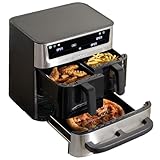
- Dual-zone or dual-basket - two independent cooking zones let you cook mains and sides at once or use as one larger oven.
- Combo models with rotisserie and multiple racks - ideal if you want a true all-in-one that handles whole chickens, trays and dehydration.
Important features and specifications to look for
Capacity and usable layout - check whether the appliance offers separate baskets, removable dividers or multi-level racks and the actual interior dimensions.
Temperature range and timer - look for a wide temperature band (about 60-230C) and a timer of at least 60-90 minutes for baking and dehydration.
Controls and feedback - digital touch displays and clear preset buttons speed up cooking; viewing windows and internal lights let you check progress without opening the door.
Accessories included - compare what you get: racks, trays, rotisserie forks, separators and mesh trays save extra spending. Some models include 7 to 13 accessories.
Cleaning and maintenance - dishwasher-safe trays and crumb pans make life easier. Stainless steel interiors outperform plastic-lined ones for durability.
Energy and noise - dual-fan convection systems cook evenly and fast but can be louder. If speed matters aim for 2,000W or more for faster results.
Temperature range and timer - look for a wide temperature band (about 60-230C) and a timer of at least 60-90 minutes for baking and dehydration.
Controls and feedback - digital touch displays and clear preset buttons speed up cooking; viewing windows and internal lights let you check progress without opening the door.
Accessories included - compare what you get: racks, trays, rotisserie forks, separators and mesh trays save extra spending. Some models include 7 to 13 accessories.
Cleaning and maintenance - dishwasher-safe trays and crumb pans make life easier. Stainless steel interiors outperform plastic-lined ones for durability.
Energy and noise - dual-fan convection systems cook evenly and fast but can be louder. If speed matters aim for 2,000W or more for faster results.

Where to buy, common mistakes and expert tips
Buy online for price comparison, wider choice and full spec sheets; buy in-store if you must check build quality, size and controls in person.
Check reviews and short video demos to confirm how presets perform and how loud the unit is.
Common mistakes to avoid:
Check reviews and short video demos to confirm how presets perform and how loud the unit is.
Common mistakes to avoid:
- Buying by label alone - capacity and internal layout matter more than the headline litre figure.
- Assuming presets match your recipes - expect small adjustments to time and temperature.
- Overlooking ventilation and counter space - allow a few centimetres around the unit for airflow.
- Neglecting accessories - cheaper models can end up costing more if you need to buy trays and racks separately.
- If you regularly cook different foods at once, choose a dual-zone or dual-basket model with sync settings so dishes finish together.
- Prefer stainless interiors and PFAS-free coatings for longevity and safer cooking surfaces.
- Count included accessories - a model with 10+ items often offers better value.
- Opt for about 2,000W for reliably fast and crispy results while keeping energy use reasonable.
Final Thoughts
Match capacity and layout to your household, favour stainless steel and PFAS-free finishes, and buy where returns and warranty are straightforward. For everyday flexibility, a mid-to-large oven-style or dual-zone unit of around 2,000W gives the best mix of speed, capacity and value.


